
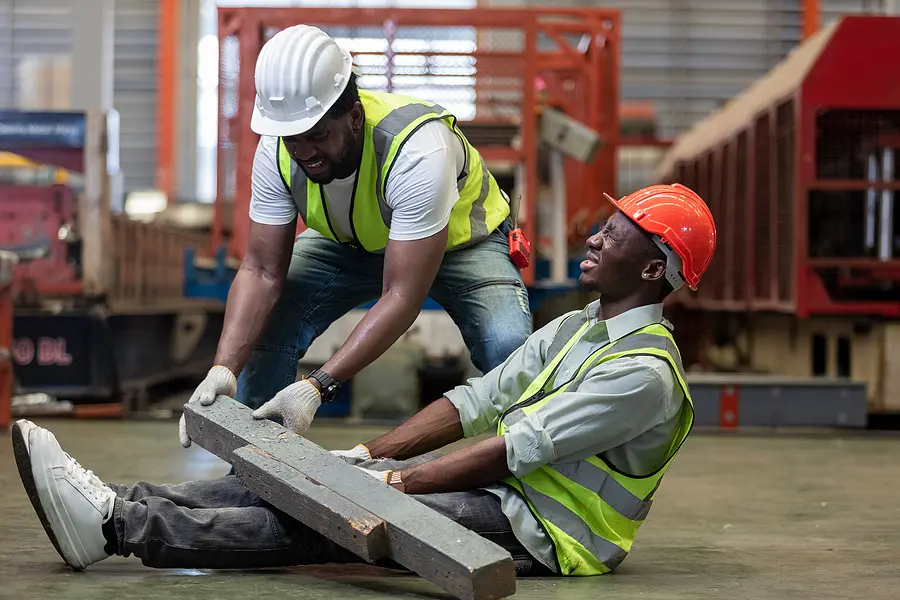
The Hudson County waterfront is one of the most active construction corridors in New Jersey. Jersey City’s skyline has changed substantially over the past decade, and the development that built it has employed thousands of construction workers in trades ranging from ironwork and concrete to electrical and mechanical systems. When a worker is seriously injured on one of these sites, the legal landscape they face is considerably more complex than most people understand. Workers’ compensation provides a baseline, but it is rarely the full picture. At The Law Offices of Anthony Carbone, construction accident cases involve a careful analysis of every party on the site, every contract between them, and every statute that governs safety obligations, because the workers’ comp check is often only one part of the compensation available.
Workers’ Compensation: What It Covers and What It Does Not
New Jersey workers’ compensation provides injured workers with medical treatment coverage, temporary disability benefits equal to 70 percent of the worker’s average weekly wage up to a statutory maximum, and permanent partial or total disability benefits if the injury results in lasting impairment. These benefits are available regardless of fault. An injured construction worker does not need to prove their employer was negligent to receive them.
The trade-off is the exclusive remedy bar. By accepting workers’ compensation benefits, an injured worker generally cannot sue their direct employer for negligence. The employer’s workers’ comp insurance is the exclusive remedy against that employer. This bar protects the direct employer from civil liability but leaves open the possibility of claims against every other party on the construction site.
Workers’ compensation benefits, while meaningful, do not fully compensate most serious construction injuries. Pain and suffering are not recoverable under workers’ comp. Loss of future earnings beyond the statutory disability benefit schedule is not recoverable. The full value of a permanent, disabling injury, particularly for a younger worker facing decades of reduced capacity and earning potential, typically far exceeds what workers’ comp provides. This is why the third-party negligence claim is often where the real recovery occurs.
Third-Party Negligence Claims: Suing Everyone Who Isn’t Your Direct Employer
Construction sites in New Jersey involve layered contractual relationships. A property owner hires a general contractor. The general contractor hires subcontractors. Subcontractors hire their own workers. Equipment is rented from third-party vendors. Safety consultants are sometimes retained. Each of these parties has its own legal duties, and an injured worker employed by one subcontractor can bring negligence claims against the general contractor, the property owner, and other subcontractors who contributed to the conditions that caused the injury.
The exclusive remedy bar that protects the direct employer does not protect these other parties. A union ironworker employed by a structural subcontractor who is injured because the general contractor failed to maintain safe scaffolding can sue the general contractor in civil court while simultaneously receiving workers’ compensation from their direct employer. The two claims run on parallel tracks, and the third-party negligence recovery is not offset by the workers’ comp benefits in most circumstances, though the workers’ comp carrier typically has a lien on any third-party settlement.
Establishing negligence against a general contractor or property owner requires showing that they had supervisory control over the means and methods of the work, or that they had actual or constructive notice of the unsafe condition that caused the injury. General contractors who hold daily safety briefings, direct the sequencing of trades, and maintain the site’s common areas generally have sufficient control to face liability when unsafe conditions in those areas cause an injury. Property owners who retained contractual authority over safety matters are in a similar position.
The New Jersey Safe Place to Work Act and What It Means for Construction Workers
New Jersey’s Safe Place to Work Act, N.J.S.A. 34:2-24 et seq., imposes a specific statutory duty on employers and property owners to provide a safe workplace. Unlike common law negligence, which requires proof that the defendant failed to act reasonably under the circumstances, the Safe Place to Work Act imposes an absolute duty to maintain the place of employment in a safe condition. A violation of the Act is negligence per se, meaning the plaintiff does not need to establish that the defendant’s conduct was unreasonable. They need to establish that the statutory duty existed and was not met.
The Act has been applied in New Jersey construction cases to impose liability on property owners who retained control over the premises even when general contractors were responsible for day-to-day site operations. The interaction between the Act, common law negligence, and the contractual relationships on a multi-party construction site is a factually intensive analysis that differs significantly from case to case.
OSHA violations are separate from Safe Place to Work Act claims but frequently appear in the same cases. A construction site fatality or serious injury that triggers an OSHA investigation may generate a citation report documenting specific regulatory violations. Those violations are admissible in civil litigation as evidence of negligence, and the documentary record created by OSHA’s investigation can be an important foundation for the third-party claim.
Common Construction Accident Scenarios in Hudson County and the Claims They Generate
Falls from scaffolding, ladders, and unguarded floor openings account for a significant portion of serious construction injuries in New Jersey. These cases frequently involve Safe Place to Work Act claims against property owners and general contractors who failed to maintain adequate fall protection systems, scaffolding that was not erected according to OSHA standards, or openings that were not covered or guarded as required.
Struck-by accidents involving cranes, falling materials, and construction vehicles are a recurring pattern on the high-rise and waterfront projects in Jersey City. When the equipment involved was operated by an employee of a different subcontractor, or when the general contractor directed its positioning, the third-party claim runs against the operator’s employer or the general contractor respectively.
Electrocution and trenching accidents, both among OSHA’s “Fatal Four” categories of construction fatalities, generate the most significant claims because the injuries are catastrophic. In trench collapse cases, the general contractor’s failure to require adequate shoring and the property owner’s failure to ensure OSHA compliance are the primary theories.
What Workers Miss by Accepting the Workers’ Comp Settlement Without Evaluating the Third-Party Claim
Workers’ compensation settlements in New Jersey require court approval and involve a formal process. But injured construction workers sometimes resolve their workers’ comp claims without ever being told that a separate third-party negligence claim against the general contractor or property owner exists. The workers’ comp system is administered by employers and their carriers with no financial incentive to inform the worker of other available claims. An injured worker who settles workers’ comp without investigating the third-party claim may be leaving the most significant portion of their potential recovery on the table.
The statute of limitations for a third-party negligence claim in New Jersey is generally two years from the date of injury. A workers’ comp case can be settled and resolved within that window, leaving the third-party claim intact if the worker acts before the deadline. Waiting too long, or assuming the workers’ comp settlement resolved everything, forfeits that claim permanently.
Contact The Law Offices of Anthony Carbone About Your Construction Accident in New Jersey
The full value of a serious construction accident claim in Hudson County typically requires pursuing both the workers’ compensation benefit and the third-party negligence claim against the general contractor, property owner, or other responsible parties. Identifying every available claim, preserving the evidence before the site is altered, and managing the lien from the workers’ comp carrier in the context of a third-party settlement requires an attorney who understands how these claims interact.
The Law Offices of Anthony Carbone represents injured construction workers throughout Jersey City, Newark, Hoboken, Hudson County, and New Jersey. Attorney Carbone has handled construction accident cases involving scaffold failures, fall injuries, struck-by incidents, and equipment accidents on the major development projects that have shaped Hudson County’s waterfront. Free consultations are available at 201-685-3442, including evenings and weekends. If you were injured on a construction site and were told workers’ comp is your only option, that may not be the complete picture.
Disclaimer: This blog post is for general informational purposes only and does not constitute legal advice. Reading this content does not create an attorney-client relationship. Results may vary depending on your particular facts and legal circumstances. Attorney advertising. Prior results do not guarantee similar outcomes.